

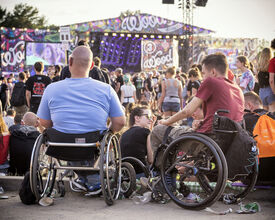
Ask a disabled music fan what going to a gig involves, and the answer rarely starts with the band. It starts with a phone line that only opens on weekday mornings, a viewing platform that may or may not exist, a taxi that costs more than the ticket, and a day of recovery afterwards.
A new UK study puts a number on that experience: 94% of disabled audience members say attending a live event exposes them to some degree of additional personal risk. Only 6% say it exposes them to none.
The figure comes from the State of Access Report 2026, published in November by Attitude is Everything, a disability-led charity that has been auditing access at British venues and festivals since the early 2010s. It is the organisation's first full report in eight years, and the first to ask disabled artists and industry professionals about their experience alongside the audience. The findings are British, and the focus is live music, but almost everything in them applies to a conference, a corporate event or a city festival anywhere in Europe.
Read the number carefully
Before building anything on that 94%, it is worth knowing what it measures. The survey ran for eight weeks from March 2026 and drew 289 responses: 223 from audience members, 32 from artists and the remainder from professionals working in the sector. The risk question asked people to rate the additional risk they take on as slight, moderate or significant; the 94% is everyone who did not answer "none". It is a self-assessment of perceived exposure, not a count of incidents, and it comes from a self-selecting sample of people with a sufficient stake in the topic to complete a long questionnaire.
None of that makes the finding less useful. It does mean the honest way to cite it is as a signal of how disabled people experience events, not as a statistic about the disabled population at large. Read that way, the more telling numbers are the ones that sit underneath the headline.
Inconsistency is the problem, not absence
The report's central observation is that access at live events has become something disabled people negotiate rather than something they can trust. Fifty-eight per cent of audience respondents think access has improved. In the same breath, two-thirds describe what is on offer as inconsistent or very inconsistent, and 13% say provisions cannot be relied on at all.
That combination explains the risk figure better than any single barrier does. If a venue sometimes has a working accessible toilet and sometimes does not, if the viewing platform is sometimes staffed and sometimes locked, then every visit involves a bet. Plenty of respondents say they have lost that bet often enough to change their behaviour: 58% have at some point been prevented from attending an event altogether, 44% now go to far fewer events than they would like, and 7% have stopped going.
A second pattern runs through the whole document. When something fails on the day, the disabled attendee is usually the one who fixes it. They find the manager, explain the legal position, propose a workaround, and frequently write to the venue afterwards so the next person has an easier time. The report calls this knowledge extraction: a sector that improves its access largely on the unpaid labour of the people it is failing. Among artists, 72% say they have helped venues improve access through their work; among professionals in non-access roles, 79% say the same.
The cost of showing up
The study also attempts something earlier editions did not: a price tag. On average, a disabled audience member spends an extra £99 per visit on things the event itself does not cover. Transport that has to be door-to-door, a companion's travel, accommodation because the last train is not an option, food because the queue is not, recovery time afterwards. Set against the roughly £128 average ticket for a major gig that the report uses as a benchmark, access adds about three-quarters again to the cost of attending.
Artists report an average of £138 in extra costs per performance, and professionals £184 per engagement plus around five unpaid hours, most of it absorbed personally. Sixty-nine per cent of audience members say they face these costs sometimes or often, and 73% say organisers rarely cover them.
The report pairs this with a commercial argument aimed at promoters and venues. Its modelling suggests disabled workers already contribute around £850 million a year in gross value added to UK live music, and that better access could release roughly £402 million in additional annual audience spending. Those estimates deserve the same caution as the 94%: the methodology is not published in detail, and the figures rest on assumptions about the wider population. But the direction of the argument is hard to dispute. People who are kept away, or who attend half as often as they would like, are revenue that walks past the door.
What is actually going wrong
The barriers respondents name most often are not the ones most organisers would guess. Physical access, the ramps and lifts that dominate accessibility checklists, sits below four other things.
- Information. The most-selected barrier is simply not knowing, in advance and in detail, what an event will be like. Respondents say accurate information beforehand makes them feel safer, and that its absence is itself a reason not to go. Vague reassurance ("the venue is accessible") is not information.
- Seating and rest. Fatigue, energy limitation and chronic illness are among the most common access needs in the sample, and they are invisible. A standing-only format with nowhere to sit excludes a large group of people who do not use a wheelchair and will never ask for a platform.
- Ticketing. Fifty-six per cent cite the booking process as a barrier. The patterns are familiar: accessible tickets released later than general sale, sold only by telephone, capped at small allocations, tied to repeated requests for medical evidence, or sold out while standard tickets are still available. Companion ticket rules are described as restrictive.
- Staff. Front-of-house staff who do not know the venue's own access arrangements, or who have no authority to deviate from them, turn a solvable problem into a refusal.
Only then come steps, distances and doorways. A venue can pass a physical audit and still fail the customer journey at the website, the box office and the first conversation at the gate.
What organisers should take from this
The report ends with 30 recommendations in three sets for audiences, artists, and professionals. Most are specific to the UK music industry, but a handful translate to any event.
- Publish one complete access journey. From the moment someone considers buying a ticket to the moment they leave the car park: how to book, what the seating options are, where the accessible toilets are and whether they are inside the secured area, how far it is from the drop-off point, what happens if the lift is out of order, who to contact. Put it on the website before tickets go on sale, keep it current, and if part of the event is not accessible, say so plainly. The book EVENTPLANNER makes the same point: telling people honestly what is not accessible is more useful than silence, because it lets them decide.
- Make accessible tickets as easy to buy as any other ticket. Same release time, same channels, same price. If you need to verify eligibility, do it once and store the answer; do not ask for a doctor's letter on every purchase. For organisers selling tickets online in the EU, this is no longer only good practice: the European Accessibility Act, which has applied to e-commerce services since June 2025, covers online ticket sales, so an inaccessible checkout is now a compliance question as well as a customer one.
- Design for rest. Seating near the action, not just in a reserved corner; somewhere quiet to recover; flexible entry so people can skip the queue in the sun. Several of these cost nothing beyond a decision made at the floor plan stage.
- Give staff the knowledge and the authority. A ten-minute briefing on where the access features are and a clear mandate to solve problems on the spot prevents most of the incidents respondents describe. Staff who have to call a manager for permission to open a side gate are the point at which "we have access" becomes "we had access, but not for you".
- Budget for the real cost. If your event requires a companion, do not charge for the companion. If the nearest step-free drop-off is a kilometre away, arrange a closer one or a shuttle. Treat these as production costs, in the budget from the start, rather than as goodwill to be negotiated on the night.
- Stop relying on free consultancy. If a disabled attendee, performer or crew member spends an afternoon fixing your access problems, you have received professional advice. Pay for it next time, in advance, from someone whose job it is.
The wider point
One in four people live with some form of disability, and the proportion rises with age. The group also includes anyone pushing a buggy, anyone on crutches for six weeks, anyone whose hearing has started to go. The lesson of this report is not that venues need more ramps. It is that access is a chain running from the website to the exit, that it breaks at its least predictable link, and that, at the moment, the people bearing the cost of those breaks are the ones with the least power to fix them.
The organisers who get this right are not the ones with the biggest budgets. They are the ones who have written down in advance what a disabled guest can expect and then made sure it was true on the day.
The State of Access Report 2026, published by Attitude is Everything, is available in full and short versions on attitudeiseverything.org.uk. Figures in this article are taken from the full report; the survey sample is small and self-selecting, and the economic estimates rest on modelling assumptions the report does not fully publish.
Source: State of Access Report 2026, published by Attitude is Everything, Photo: iStockPhoto 1004712184