


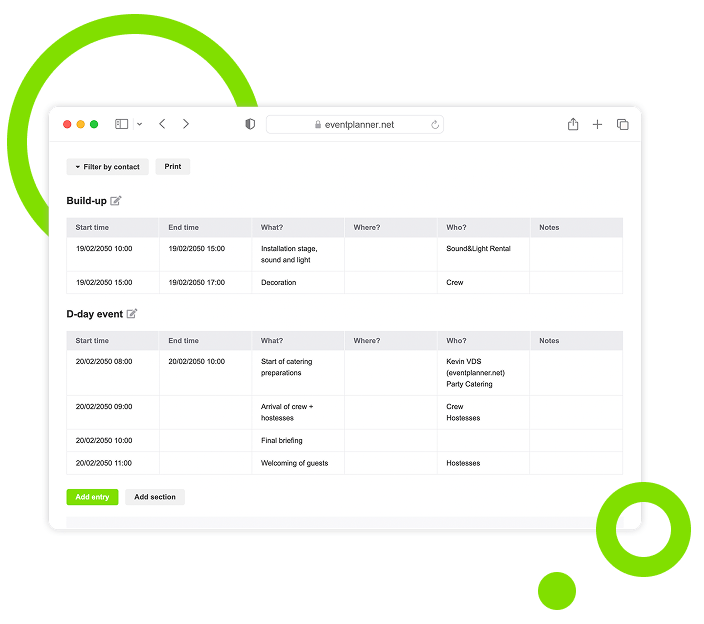
Assign Costs and Track Revenue With Event Budget
Know exactly where your money goes. Allocate costs to the right event items, track incoming revenue, manage revenue, and cut overheads.
Trusted by 179,000+ Event Organisers












Keep Your Event Spending Clear and Flexible
Stop wasting time with scattered spreadsheets and financial guesswork. Manage your event finances in one place and make confident, data-driven decisions.
Own and Control Your Event Finances
- Track costs and revenue to avoid surprises.
- Stay organised with a clear category overview.
- Save time with automated budget processes.
Adjust Your Budget When Plans Change
- Update costs automatically as planning evolves.
- Make quick decisions with real-time financial data.
- Handle exceptions with simple manual edits.
Maximise Profitability and Minimise Risks
- Capture revenue to avoid missed opportunities.
- Optimise pricing to match attendee count.
- Visualise profit margins instantly.
Team Up Without Breaking the Event Budget
- Avoid confusion with secure shared access.
- Work faster with clear roles and permissions.
- Track every change to guarantee reliability.
Prepare and Plan for Any Financial Situation
- Test budget strategies by creating scenarios.
- Account for best-case and worst-case outcomes.
- Compare scenarios for better financial decisions.
- Keep shared costs in step across every scenario.
Simplify VAT Settings for Your Events
- Support accurate budgeting with VAT handling.
- Avoid errors with VAT-inclusive or exclusive modes.
- Improve cost transparency with clear VAT settings.
Discover Your Event Planning Toolkit
Learn how event budgeting integrates with other planning features within our event software.
Moodboards
Capture ideas, curate inspiration, and explore vendors to shape your event's vision, theme, and personality.
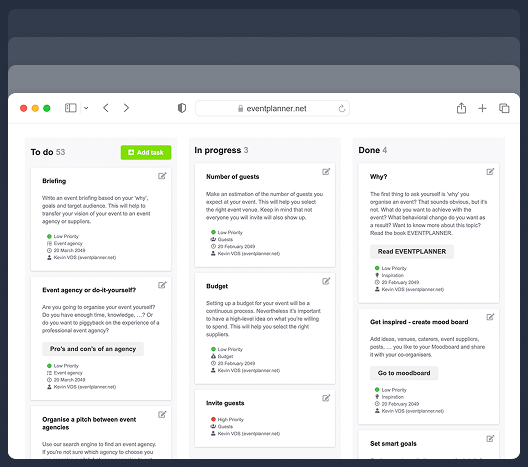
Checklists
Keep track of every planning detail. Create and assign tasks to your team members, and never miss a deadline.
Ticketing
Generate event tickets and manage on-site registration. Create easy check-in experiences for your attendees.
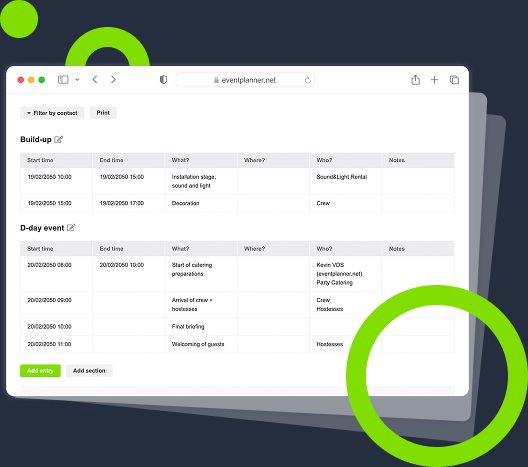
Call Sheets
Create a task list for pre-event and event days. Organise your team so everyone knows their responsibilities.
Suppliers
Manage every event partner from one workspace. Link them to budgets, call sheets, and the briefings they need.
Briefings
Build structured briefings that combine generic and supplier-specific instructions, all linked to the right partner.
Event Diagramming
Draw your event floor plan to scale, place tables, stages, bars and walls, and send the layout to your venue.
3D Event Design
Turn your floor plan into a 3D model, walk through it and view the venue before the event.
Plan / Seating
Design a floor plan, assign guests to seats, or let ticket buyers pick their own seat while ordering.
Event Budget Setup
Get a clear view of your event finances by creating and customising your budget plan.
Create Your Event Budget
No need to design a new spreadsheet. Simply add key details to generate a budget template in seconds.
-
Give your budget a name for easy identification.
-
Define the sum allocated to guide your spending.
-
Specify the number of attendees to estimate costs.
Add Budget Items
Microphones, catering, venue, decor, and tablecloths? Track your budget items to gain visibility over spending.
-
Create as many budget items as you need.
-
Set pricing: fixed, per-unit, or a mix of both.
-
Link budget items to a supplier for easy oversight.
Categorise Budget Items
Organise your event items to track specific costs and gain a structured view of your budget.
-
Select a category such as venue for each event item.
-
Choose whether the item is a cost or revenue.
-
Group and view all items automatically by category.
Set Budget Parameters
Customise key budget variables depending on your event type and characteristics.
-
Use parameters like attendee count or VAT.
-
Set budget-wide settings for pricing inclusivity.
-
Adjust default parameters for specific needs.
Dynamic Budget Adjustments
Readjust your budget automatically based on event planning changes to maintain financial accuracy.
Recalculate Items Automatically
Manual updates are error-prone when event variables change. Recalculate your event budget in real time.
-
Link items to parameters like attendee count.
-
Sync parameter changes across budget items.
-
Automatically update budget based on changes.
Change Item Costs Manually
Some cost units require manual overrides rather than automated adjustments.
-
Access cost units for individual budget items.
-
Modify units directly in the budget item editor.
-
See manual change reflected in the overall budget.
Event Revenue Management
Track, calculate, and optimise event revenue streams for a healthy financial balance.
Add Revenue Sources
Events generate revenue from multiple streams. Track them systematically for accurate insights.
-
Include revenue items in your event budget.
-
Assign categories to your revenue streams.
-
Organise revenue by categories for control.
Track Attendee-based Revenue
Calculate and adjust your revenue dynamically in real time as attendee numbers increase.
-
Set per-unit rates such as ticket price per guest.
-
Link revenue calculations to attendance.
-
View revenue numbers changing automatically.
Monitor Revenue Versus Costs
Balance event revenue against costs. Gain real-time insights into your profit and loss.
-
See current data on costs and revenue.
-
Generate reports for precise decision-making.
-
Spot cost overruns or weak revenue streams.
Collaborative Budgeting
Let your team members and event stakeholders collaborate on budget planning and decision-making.
Share Budget Access
Enable secure budget planning by allowing input from your team members or stakeholders.
-
Set role-based permissions for team members.
-
Grant external stakeholders access to your budget.
-
Monitor and adjust access permissions as needed.
Adjust Budget Collaboratively
Work with your team members and stakeholders to make real-time changes to the event budget.
-
Allow team members to make budget changes.
-
Align decisions with input from stakeholders.
-
Keep budget updates visible to everyone.
Budget Version Control
Create, manage, and compare multiple budget versions so you are prepared for every possible outcome.
Create Budget Scenarios
Budget planning often requires testing different approaches to find the best financial strategy.
-
Copy a budget to create a new version.
-
Adjust budgets independently across versions.
-
Switch between versions for comparison.
Manage Budget Versions
Create and label budget versions to organise your planning. Track updates by saving separate versions.
-
Save and label different versions of the budget.
-
Easily access older versions for reference.
-
Compare changes between versions.
Link Lines Across Versions
One supplier quote can sit in every version of your budget. Link the line once and the versions stay in step.
-
Choose the versions a new line belongs in.
-
Edit the price once and every linked version follows.
-
Unlink a line when a version needs to differ.
Basic Tax Management
Simplify basic tax handling and ensure your budget aligns with financial obligations.
Configure VAT Handling
Explore flexible VAT management options for different event types and jurisdictions.
-
Choose VAT-inclusive or exclusive modes.
-
Set VAT rates at the budget line level.
-
Automatically calculate VAT for accuracy.
Manage VAT Separately
Access advanced options to calculate and display event VAT separately.
-
Enable VAT-exclusive pricing via event settings.
-
Enter VAT percentages for each budget item.
-
Automatically calculate VAT totals separately.
Event Budget, a Tool for Control and Profitability
Gain complete financial oversight of your event. Plan budgets, track spending, and manage revenue to keep your event planning on track.
Oversee Finances, Plan with Confidence
Simplify complex budgeting. See costs and revenue in one place for quick action.
Adjust Dynamically, Stay in Control
Adapt to changes. Update budgets in real time and maintain financial accuracy as plans evolve.
Balance Your Revenue and Costs
See your numbers clearly. Avoid overspending and optimise revenue to meet your financial goals.
Refine Budget Strategy, Repeat Wins
Use insights from past budgets to refine your process. Make better decisions and drive profits.
Frequently Asked Questions
-
How can I adjust my budget if event details change after planning?
Yes. Whether attendee numbers, vendor prices, or unexpected expenses change, you can update your budget in real time. Automated updates sync across your budget items, and you can manually override specific cost items when needed. You can also create separate budget versions for different scenarios.
-
Can I track revenue and costs in separate categories?
Yes, the budget module lets you categorise both costs and revenue independently. You can assign items to categories such as venue, catering, or ticket sales. This keeps your overview clear and allows automatic grouping by category.
-
What if I need to make changes to my budget?
You can update your budget at any time with current financial data. As event variables change, you can adjust costs and revenue accordingly. The budget reflects those updates immediately.
-
What happens if I need to adjust my budget based on fluctuating revenue?
You can adjust revenue by updating attendee numbers or other revenue factors. The budget updates automatically based on those changes. You can also create multiple budget versions, such as best-case and worst-case scenarios.
-
Can I store historical versions of my budget for future reference?
Yes, you can store and label multiple budget versions for future reference. This is useful for tracking budget evolution, comparing versions, and reviewing previous adjustments.
-
Do I have to update every budget version by hand when a price changes?
No. When your event has more than one budget version, a new budget line asks which versions it belongs in. Pick two or more and the line is linked: change its price, its supplier or its description in one version, and every version it is linked to updates with it. A revised supplier quote becomes one edit instead of one per version. Linked lines are marked with a small icon in the budget, so you can always see which lines are shared and which are local to the version you are looking at, and the edit form tells you how many versions your change will reach before you save.
-
Can linked budget lines have a different number of guests per version?
Yes, and that is what makes linking worth using. A linked line shares its price, not its number of units. The same catering line can sit in three versions at one agreed price per head, with the base version planning for 200 guests, the premium version for 300 and the fallback for 150. Agree a lower price per head and all three versions pick it up; the guest counts stay exactly as you set them. If one version needs to go its own way, unlink the line there and it belongs to that version alone, while the other versions stay linked to each other. Unlinking cannot be undone, so it is meant for versions that have genuinely diverged. Deleting a linked line removes it from every version it is linked to, and the confirmation says so, with the option to unlink it first if you only want it gone from one.
-
How do I manage complex event budgets with multiple suppliers and vendors?
You can link budget items to specific suppliers or vendors. This simplifies financial management, helps track costs per supplier, and aligns pricing and invoices clearly.
-
How do I collaborate with my team and stakeholders on the budget?
The system supports collaboration through secure shared access. You can assign role-based permissions so the right people have the right level of budget access.
-
What categories should an event budget include?
A complete event budget typically covers eight categories: communication (website, print, marketing, ticketing fees), location (venue rental, furniture, decor, sanitation, parking, cleaning), catering (food, drinks, crew catering, glassware), programme (entertainment, speakers, activities, music rights), technical production (audio, video, lighting, streaming, Wi-Fi), staffing (event managers, security, hostesses, first-aid, stagehands), miscellaneous (transport, hotels, permits, insurance, waste), and overheads (event software, taxes, and a buffer for unforeseen costs). eventplanner.net's budget templates start from these categories by default. The full checklist is in the book EVENTPLANNER by Kevin Van der Straeten.
-
How much buffer should I include in an event budget for unforeseen costs?
A common rule among experienced organisers is to set aside roughly 10% of the total budget as a buffer for unforeseen costs - last-minute supplier overruns, damages, additional security needs, weather contingencies, or anything else the original plan did not anticipate. For higher-risk formats (outdoor festivals, multi-day events, international logistics), 15% is more realistic. The buffer is not a discretionary spend; treat it as protection for the budget you've already committed to.
-
What's the difference between fixed and variable costs in an event budget?
Fixed costs do not change with attendee numbers - speakers, AV equipment, venue rental, entertainment. Variable costs scale with the number of guests - catering, drinks, printed materials, registration packs. The split matters because it tells you the break-even attendee count for paid events and the stress-test range for corporate events: if 10% fewer people show up, your variable costs drop, but your fixed costs do not. Some costs are fixed up to a ceiling - a venue rental is fixed until you exceed capacity and have to upgrade - and those step-changes are where budgets typically slip. eventplanner.net's budget tool lets you flag items as fixed or attendee-linked, so the totals recalculate automatically when guest numbers change.You can also save multiple versions of the same budget side by side - a low-attendance scenario, a target scenario, a sold-out scenario - so you can pinpoint your break-even point and see exactly how the numbers shift as guest counts change.
-
Is event budget software better than Excel or Google Sheets?
Excel works, and many organisers start there. The point at which it stops working is usually one of three things: you need to update the budget while collaborating with a team and version conflicts start appearing; attendee numbers change and every linked formula has to be re-checked manually; or the budget needs to stay in sync with suppliers, briefings, and the run-of-show, which a spreadsheet cannot do without manual reconciliation. Event budget software solves those three problems. It does not give you anything Excel cannot - but it gives you the structure that's already there for events, and the integration with the rest of your planning that a spreadsheet, by definition, cannot offer.
-
Can I track sponsorship income and ticket revenue alongside costs?
Yes. The budget tool treats revenue and costs symmetrically - every line can be flagged as a cost or a revenue stream, and revenue can be linked to attendee numbers (per-ticket pricing) or set as fixed (sponsor fees, grants). Net profit and break-even attendance recalculate automatically. This matters most for paid public events and conferences where ticket pricing strategy, sponsor packages, and the variable costs they unlock all need to balance into a viable business case before launch.
-
How do I plan cashflow for an event, not just the total budget?
A balanced budget on paper can still leave you cash-poor in execution - many events incur most costs (deposits, venue, equipment) before any revenue (ticket sales, sponsorship instalments) lands in the account. Map expected revenue inflows against committed payments week by week from the planning kick-off through the post-event invoicing window, and identify any periods where the cash position would go negative. Where it does, you have three options: renegotiate payment terms with suppliers, secure a short-term financing line, or shift revenue forward (early-bird tickets, sponsor deposits up front). eventplanner.net's budget supports multiple versions, so you can model best-case and worst-case cashflow scenarios side by side. Dedicated cashflow planning - mapping inflows and outflows week by week directly inside the platform - is on the roadmap and coming to eventplanner.net in a future release.
-
What's the best event budget software for a small wedding or private event?
eventplanner.net is initially built for professional events - corporate events, conferences, festivals, product launches, exhibitions, and any format where multiple suppliers, team members and budget lines need to stay in sync. The same tools the professionals use are equally available for private events and weddings, and many couples planning a wedding over 12+ months find the budget integration genuinely useful: keeping the budget aligned with the supplier list, the moodboard, the timeline and the run-of-show saves more time than a spreadsheet does once the event grows beyond a handful of suppliers. The free tier covers a single private event at no cost, so there's no commitment if you want to try the full toolset on your own wedding or family event before deciding. Couples and planners looking specifically for wedding planner software can use the same toolset, with templates pre-tuned to a 12-month wedding planning timeline.
free forever
Perfect for professionals and smaller event planning teams managing one event at a time.
from per seat/month
Great for professionals and larger teams managing multiple events at a time.
from per month
Perfect for organisations requiring custom solutions, advanced security, and dedicated support
Event Planning Software That Grows With You
Select a plan that matches your ambitions, whether you're managing a single event or running multiple projects simultaneously.