


Open the registration data for any corporate event of a few hundred people and look at the free-text field labelled 'dietary requirements'. You will find vegetarian, vegan, and gluten-free options. You will find halal and kosher. You will find "no fish", "lactose intolerant but cheese is fine", "nut allergy (severe)", "pescatarian but I eat chicken", "nothing with a face", and at least one "low carb please".
Then look at what happens to that field. In most organisations it is exported to a spreadsheet, totalled into a few numbers, sent to the caterer three days before the event and never looked at again. That is where the trouble starts, because the dietary field is not a catering question. It is where food safety law, hospitality, cost, and reputation meet, and the organiser stands in the middle of all four, whether they know it or not.
The thing most organisers get wrong first
The field mixes together three completely different things, and the first job is to separate them.
- A preference is a choice: vegetarian, vegan, no red meat, low carb. Getting it wrong is disappointing. Nobody is harmed.
- A religious or ethical requirement is also a choice, but one that is non-negotiable for the person making it: halal, kosher, Hindu vegetarian, Jain. Getting it wrong is not disappointing; it is offensive, and it can mean a guest eats nothing all day at an event where you are the host.
- An allergy or medical condition is neither. Coeliac disease, a peanut allergy, a shellfish allergy. Getting it wrong can send someone to hospital, and in the worst case it kills. Food-induced anaphylaxis is rare, but severe reactions in Europe are reported every year, and a share of them happen in restaurants and at catered gatherings rather than at home, precisely because that is where people eat food they did not prepare and cannot see into.
A single free-text box treats all three the same. Your caterer, reading a line that says 'no nuts', cannot tell whether the guest dislikes walnuts in the salad or carries an adrenaline auto-injector.
So they do what any reasonable person does with ambiguous information at scale: they treat it as a preference. The entire risk chain starts with the registration form, which is yours, not the caterer's.
Ask the question properly
The fix is to stop asking one question and ask two or three.
- The first is a short, fixed list that covers the common cases and that you can count: vegetarian, vegan, halal, kosher, no pork, no alcohol in food, gluten-free, lactose-free. These are the quantities your caterer needs, and a tick-box produces clean numbers where a free-text field produces a spreadsheet full of synonyms.
- The second is separate and the one that matters: Do you have a food allergy or a medical dietary condition? If yes, which one, and how severe. Keep it in its own box, label it as a safety question, and tell the registrant what you will do with the answer. People with serious allergies are used to being ignored and tend to under-report; a form that says "we pass allergy information to our caterer by name and will have a labelled plate ready for you" gets more honest answers than one that lumps allergies in with "other remarks".
- The third is optional and only for events where you serve plated food: a free-text "anything else we should know" box, read by a human.
Then do the thing almost nobody does: close the question at a sensible date, and say so. A registration form that remains open until the morning of the event results in a steady trickle of late requirements that never reach the kitchen. Set a cut-off ten days out, tell people that requirements submitted after that date will be accommodated where possible, and build a plan for the ones that arrive anyway, because they will.
Whatever tool you register people with, this is a form design decision, not a software one. If you use eventplanner.net's registration and ticketing, the custom questions are handled there. What matters is that allergies and preferences never share a box.
What the law actually requires, and from whom
Across the EU, the Food Information to Consumers Regulation (1169/2011) requires that information on fourteen named allergens is available for all food, including food that is not pre-packed, which is nearly everything served at an event. The fourteen are cereals containing gluten, crustaceans, eggs, fish, peanuts, soybeans, milk, nuts, celery, mustard, sesame, sulphites above a threshold, lupin and molluscs. How that information must be given for non-prepacked food is left to each member state, which is why the rules look slightly different on either side of a border.
In some countries like Belgium, the royal decree implementing this allows allergen information to be provided orally, but only if the business has a written procedure and the information is available in writing upon request. In the Netherlands, the NVWA takes a similar line: oral information is acceptable, provided guests are told they can ask, staff can answer, and a written record (an allergen matrix of dishes against the 14 allergens) is kept behind the counter. In the UK, since the 2021 "Natasha's Law" changes, any food packed on site before it is ordered, from a boxed lunch to a pre-poured and lidded coffee, needs a full ingredients label with allergens emphasised, and for buffets the guidance is explicit that allergen information must be given per dish, not for the buffet as a whole. In France, the Netherlands, Ireland, and most other member states, the rules sit somewhere between written and oral forms, and the details vary.
Two points in all of this concern you directly as organiser rather than the caterer. First, the duty rests with the "food business operator" serving the food. For a straightforward catered event, that is the caterer. But if your organisation buys in food and serves it itself, runs its own bar, or hands out sponsored snacks, it may be the food business operator for that food, with all the obligations that entails. Many corporate event teams are, legally, running a small catering operation for one day without realising it.
Second, the law is about information, not about outcomes. A caterer that tells a guest a dish contains nuts has done what the regulation requires, even if the guest then eats it. The law does not require you to accommodate anyone's diet; it requires you not to mislead them about what is in the food. Everything beyond that, the vegan option, the halal main, the separate plate for the coeliac guest, is hospitality, which is a higher standard than the law and the one your guests will judge you by.
Get it to the plate
Between the registration form and the plate, there are three handovers, and each one loses information.
The first is from you to the caterer. Send counts for the preference list and a separate, named list of allergies and medical conditions, including severity, in writing. Do not send the raw export. Then ask the caterer three questions and get the answers in writing: how will each allergy be handled on the day, what is your procedure for cross-contamination, and who on your on-site team knows. A caterer that cannot answer the third question has no procedure, whatever their proposal says.
The second handover is from the caterer's office to the caterer's kitchen and serving staff. This is the one you cannot see, and the one where most failures happen. The way to check it is to walk the service on the day: find the person named in answer three, ask them to show you how the gluten-free guest will be served and where that plate is kept. If they have to go and ask someone, you have found a gap in time to fix it.
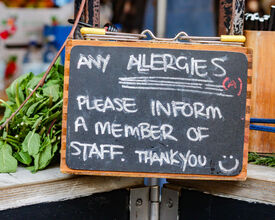
The third handover is to the guest. People with serious allergies need to know what is safe without having to have a conversation at a busy buffet. Label every dish on the buffet with its name and its allergens (not a general "ask staff" sign, which puts the burden on the person at risk) and keep a printed allergen matrix at the service station for anyone who asks. For plated dinners, the named guest gets a named plate, and the serving staff have the list. For people who told you about a severe allergy in advance, the single most reassuring thing you can do is have a named member of staff find them before the meal and tell them what has been arranged.
The buffet problem
A buffet is where good intentions go to die. The vegan dish is placed next to the beef, and the same tongs serve both. The gluten-free bread is on the same board as the baguette. The one guest who needed the labelled plate finds it has been put out on the buffet and eaten by someone who thought it looked nice.
Three rules help. Keep anything prepared for an allergy off the buffet altogether; hold it back and serve it to the named guest. Put the dishes for the most common requirements (vegetarian, vegan, gluten-free) at the start of the line, not the end, so they are not depleted or contaminated by the time the people who need them arrive. And give every dish its own serving utensil, labelled, with a member of staff whose only job for the first fifteen minutes is to put tongs back where they came from.
For walking dinners and canapé service, where nothing is labelled and everything passes by on a tray, brief every member of serving staff on the allergens in every item they carry, or print a small card for the tray. "I'll go and check" is an acceptable answer; "I think it's fine" is not.
What it costs, and what it costs not to
Dietary requirements have a budget line, and it is larger than most organisers plan for. Separate preparation, separate utensils, a named plate, more staff at the buffet, a caterer who has done this properly rather than cheaply: expect it to add a few percent to the catering bill, and more on small events, where a single kosher meal has to be sourced from a certified supplier at several times the per-head rate.
Put it in the budget before you ask for quotes, not after, and ask caterers to price it explicitly rather than absorbing it into "per head". A caterer who says dietary requirements are included at no extra cost is either very good or not doing them.
Then weigh it against the alternative. A guest who leaves your gala hungry because the kosher meal never arrived tells that story for years. A guest who spends the evening in hospital is a story your legal counsel and your insurer get to hear as well. Measured against either, the budget line is small.
The one-page version
Separate preferences, religious requirements and allergies on the registration form; never let them share a box. Ask about allergies as a safety question, by name, with severity, and say what you will do with the answer. Close the question ten days out and plan for late arrivals. Send the caterer counts for preferences and a written list with names for allergies, and get their handling and cross-contamination procedure back in writing, with a named person on site. Know whether your organisation is serving food itself and therefore a food business operator. Label every buffet dish with its allergens; keep allergy plates off the buffet and serve them by name. Brief tray staff on every item. Budget for it explicitly. And have one person find every guest with a severe allergy before the meal and tell them what has been arranged.
None of that is the caterer's job. The caterer cooks what they were told, for the numbers they were given, under the procedure they were asked for. Everything before that and the decision to check belong to the organiser. Which is the point: the people who get this right are not the ones with the best caterer. They are the ones who understood that the question on the form was theirs to ask properly.
Source: Photo: iStockPhoto 2227984793