


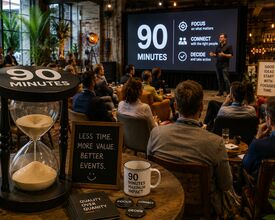
Somewhere in the last few years the default event stopped being obviously worth a day. Diaries got denser, travel budgets got scrutinised, and the person you most want in the room became the person least able to give you eight hours.
So organisers have started designing downwards: the half day, the breakfast briefing, the 90-minute format that starts at four and is over before the evening.
Done well, this is one of the most effective moves available to an organiser. Done badly, it is a full-day agenda with the interesting parts removed. A compressed conference that satisfies nobody, where the keynote is rushed, the panel is pointless, and there is no time to talk to anyone.
The difference lies in understanding that a 90-minute event is not a short conference. It is a different object, with its own arithmetic. This is what that arithmetic looks like.
First, the argument you should not use
The usual justification for short formats is that attention spans are collapsing. You will have heard that people can only concentrate for ten minutes, or that TED settled on 18 minutes because that is where the brain gives up, or that we are now down to the attention span of a goldfish.
None of that survives contact with the research. A 2016 review in Advances in Physiology Education traced the ten-minute attention span back through decades of citations to a single 1978 paper, which was a literature review about note-taking, not attention, and whose own authors conceded that note-taking is not necessarily indicative of attention at all. An earlier review in Teaching of Psychology reached the same conclusion: the research offers little support for the belief that attention declines after ten to fifteen minutes. The goldfish figure came from a marketing report and described time spent on a web page. TED's own explanation of the 18-minute limit is about editorial discipline, not neuroscience. It is long enough to say something meaningful and short enough to hold an audience, and the founder who set it said plainly that the number was partly chosen because "15 minutes" was being interpreted as 25 minutes.
More awkwardly for the short-format argument, the workplace research points the other way. A 2023 evidence review by the CIPD found only three studies examining meeting duration, and none found a significant relationship between meeting duration and effectiveness. What did correlate negatively with outcomes was meeting frequency. Length is not the variable.
What the evidence does support is more useful than the myth. Attention declines gradually and continuously from the first minute rather than falling off a cliff at a fixed point. Lapses are short and cyclical: a clicker study of chemistry lectures found students reporting attention lapses within the first 30 seconds and then at roughly four-and-a-half-minute intervals, with brief lapses vastly outnumbering long ones. And most importantly, interaction buys attention back, and the effect persists. In that same study, the lecture segment immediately after an interactive question had significantly fewer lapses than the segment before it.
The corollary matters for anyone designing a short event. A separate experiment on segmented video lectures found that merely chopping a session into pieces did nothing; the benefit came from putting an actual task at the seam. A pause is not an intervention. A question is.
So the honest position is this: 90 minutes is not better because human attention has shrunk. Ninety minutes of one person talking is just as bad as three hours of it. The case for the short format is economic and strategic, not neurological.
The real case: the arithmetic of other people's time
Here is the number that should drive the decision. Eurostat put average hourly labour costs across the EU at €34.90 in 2025, and €38.20 in the euro area. Take a modest 90-minute event with 100 attendees. That is 150 person-hours, or roughly €5.200 of your audience's employers' money, before anyone travels anywhere. Now take a two-day conference with the same hundred people and sixteen hours of programme. That is 1.600 person-hours, around €55.800, and now you are also buying flights, a hotel night and two days of someone not doing their job. Imagine having a room full of C-level people with slightly higher pay grades...
You do not see that cost. Your attendees' finance directors do. And the events industry's own benchmark metric quietly concedes the point: cost per attendee is conventionally expressed on a per-day basis. In the 2024 Amex Global Business Travel forecast, a small or simple meeting in Europe ran around $514 per attendee per day excluding airfare. Remove a day, and you remove roughly a day's cost per head, on both sides of the ledger.
That is why the short format wins where it wins. Not because people cannot concentrate, but because you are asking for dramatically less and can therefore ask much more successfully. It is the format that gets you the operations director who would never clear two days, and the regional audience who would never fly.
The 2026 Amex forecast points in the same direction from the attendee side: 34% say they want events closer to where they are based, and the report notes that sessions are getting shorter to make room for longer networking breaks. Its blunter line is worth pinning above a planning meeting: a great event does not mean an intensely packed agenda.
The 90 minutes you do not actually have
Now the hard part. A 90-minute event does not contain 90 minutes of programme, and this is where most of them fall apart.
Registration eats the front end. A reasonable planning figure is around 30 seconds per check-in, so roughly 120 people per staffed desk per hour. Two hundred attendees through two desks is fifty minutes of arrivals. In a full-day event that is invisible, absorbed by a coffee and a slow start. In a 90-minute event, it is a third of your programme. Either pre-issue badges, go to self-scan, or accept that your event begins with a queue.
A conventional coffee break is fatal. Practitioner guidance puts a useful networking break at 20 to 30 minutes - below twenty minutes people do not get past introductions - plus ten to fifteen minutes of transition either side to move a room. That is 30 to 45 minutes, a third to a half of everything you have. This is the structural reason good short formats either have no break at all or make the break the event.
Speech is slower than you think. At a normal presentation pace of about 150 words a minute, 90 minutes is around 13,500 words spoken aloud, the length of a substantial book chapter. That sounds like room for a lot. It is not, because the constraint is not delivery; it is retention. The defensible figure for working memory is roughly four chunks, not seven, and nobody leaves a session carrying eight ideas. Plan for two, or three at the very most, and build everything around them.
Put those three together, and the real budget of a 90-minute event looks like this: about 75 minutes of usable time, one transition at most, and two or three ideas. Anything more is decoration.
Two agendas that work
A content format, where the outcome is that people know or can do something:
Doors and self-scan check-in from minus fifteen. Straight into a 20-minute framing talk with no welcome address. A 25-minute working segment where the audience does something - a structured exercise, a live problem, a worked case - in table groups. Ten minutes of harvest, where three tables report and the speaker responds to what actually came up. A 15-minute closing talk that lands the two ideas, written to react to the room rather than delivered blind. Then the room stays open, and drinks appear, with the explicit message that the programme is over and nobody has to stay. Total programme: 70 minutes. One seam, filled with a task rather than a pause.
A connection format, where the outcome is that people meet the right others:
Same arrival. A 10-minute stage set-up that gives the room a shared frame and a genuinely good question. Then three rounds of 20 minutes at tables of four, in the World Café pattern, with one host staying and everyone else moving. A 10-minute close that captures what the room concluded. Seventy minutes again, and every attendee has had three substantive conversations rather than one accidental one. Note that this version has no keynote at all, and is usually the more valuable of the two.
What to cut first
The order matters because organisers instinctively cut in exactly the wrong sequence — protecting the ceremony at the expense of interaction.
Cut the ceremony. The welcome address, housekeeping, the thank-you to the sponsor, and the introduction of the speaker. Nobody has ever travelled across a city for it. Fold safety information into a slide and the sponsor into something they would actually value, and you have recovered ten minutes before you have touched the programme.
Cut the panel. Four people who have not prepared together, moderated by someone being polite, is the lowest information density per minute of any format in professional events. In a 90-minute event it is unaffordable. If you need multiple voices, interview two people thoroughly for 15 minutes each.
Cut the second speaker. One well-prepared talk plus something the audience does will always outperform two talks. The second keynote is usually there to justify the event's existence, which is a marketing problem, not a programming one.
Cut the standalone coffee break - and reinvest the time in a structured conversational round. You get the networking value people actually came for, without the transition cost or the awkwardness of standing in a room where nobody knows anyone.
Convert open-mic Q&A into something structured. Undifferentiated Q&A is where a short event dies: two long questions from the same confident person and eleven minutes gone. Replace it with a task at the seam: table discussion producing one question each, a poll, and a written prompt. This is the evidence-backed move, and it is also faster.
What you do not cut is the interaction. That is the thing that buys back attention and makes 90 minutes feel generous rather than thin.
Where short genuinely beats a day
When the outcome is a single decision, skill or introduction. If you can write the objective as one sentence starting "afterwards, they will...", the short format is probably right. If it takes a paragraph, you are running a conference.
When seniority is the constraint. The whole argument for 90 minutes is access. A format that gets fifteen decision-makers into a room for an hour and a half is worth more than one that gets their deputies for two days.
When the audience is regional. This is also where the sustainability argument is real, and it is worth being precise, because most articles get it wrong. In a peer-reviewed 2025 study of scientific conference travel, attendee travel exceeded one tonne of CO2e per person for a European event, rising to four or five tonnes for intercontinental ones, while accommodation accounted for only 10 to 20 kg per person per night. Cutting a hotel night therefore saves perhaps one or two per cent of the footprint. The genuine saving comes from the short format changing the catchment: people come by train from two hours away instead of flying in from three time zones, or do not travel at all. Design for the radius, not the hotel bill.
When you want it to recur. A quarterly 90-minute format builds a habit in a way an annual event cannot. But hold the CIPD finding in mind - frequency, not length, is what correlates with people disengaging. Four times a year is a rhythm; monthly is a calendar invitation people start declining.
And yes, it can carry sponsorship. Freeman's 2026 attendee research found 84% view sponsored sessions neutrally or positively when the sponsorship is clearly disclosed. The published rulebooks of the short formats that scaled globally show how: Ignite caps sponsor commercials at fifteen seconds, bans logos on stage and prohibits sponsors from controlling content or pitching during talks. Constrain the sponsor's airtime and protect the content, and you can sell a short event without hollowing it out.
Where it does not
Be honest about the limits, because overselling the format is how it gets discredited.
Short cannot build a community. Freeman's research is consistent on this: attendees say they would ideally spend more than half their learning time outside traditional session rooms, and around half say successful networking alone is reason enough to come back. Trust, serendipity and the difficult conversation all need loose time, and loose time is the one thing a 90-minute event does not have.
Nor can it do genuine open-agenda work. Open Space Technology, the most established unconference method, sets its minimum viable duration at five hours and describes it as tight. If you want the room to set the agenda, you need most of a day.
And it cannot carry a broad programme. Multiple tracks, an exhibition, awards, a general assembly: these are day-shaped things. Compressing them produces the worst version of every one.
Steal the rule, not the format
One pattern in the short-format world is worth copying above all the others. The formats that spread globally are the ones whose timing rules are non-negotiable and, ideally, enforced by a machine rather than a person.
PechaKucha, invented in Tokyo in 2003, is 20 images at 20 seconds each: six minutes and forty seconds, auto-advancing, with eight to fourteen presentations in an evening. Ignite is 20 slides at 15 seconds: five minutes flat, and its published rules state that this is not a framework that can be modified. World Café specifies 20-minute rounds and four chairs per table. Lean Coffee gives each topic a five-minute timebox and then holds a vote on whether to continue.
None of these relies on a chairperson tapping a watch, because that never works. The slides simply move on. If you are building a 90-minute event, decide the timing rule first, make it automatic, and tell your speakers before they write anything. A speaker given twenty minutes writes a twenty-minute talk; a speaker given twenty minutes three days beforehand writes a forty-minute talk and delivers half of it.
One last note, in the interest of honesty. Despite how much has been written about shorter events, no organiser appears to have published a proper before-and-after - attendance, satisfaction, revenue and sponsor response - from cutting an event's duration. The industry has plenty of opinion on this and very little data. If you run the experiment, publish the numbers. Everyone designing downwards is currently doing it on judgement alone.
Source: Illustration generated with AI