

Anyone who thinks of the electrification of events often thinks of batteries, solar panels and major investments. A small fair in Mortsel shows that it can sometimes be much simpler.
One big attraction, one diesel generator
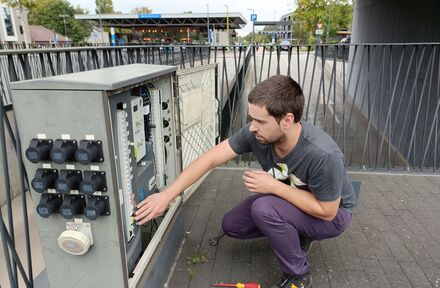
In the project Events in stroomversnelling (an initiative by Ecofest and Measure.io, with support from Nationale Loterij), we are testing how events can manage electricity more intelligently. One of our test cases is the September fair in Mortsel: a small fair with around six stalls. Only one of them runs on a diesel generator: the bumper cars. The other stalls are connected to the mains via market distribution cabinets, like the ones you see everywhere in cities and towns. So why aren’t the bumper cars connected to these market cabinets, Stijn has been wondering for a few years (as a Mortsel resident and fairground fan).
The figures
The City of Mortsel was enthusiastic about joining the ‘Events in stroomversnelling’ project. The first step was to map out consumption and capacity. Measurements in 2025 showed that the market cabinets have sufficient capacity. What is missing are the right connections: there are no 63A plugs. In theory, this is a simple and inexpensive adjustment.
That is why we worked out the figures together with the bumper car operator:
- Red diesel currently costs around 1.60 euros per litre. It once cost 60 cents.
- His 45 kVA generator consumes 5 litres per hour.
- At 10 operating hours, that comes to 80 euros per fair day, and 400 euros over the five fair days.
- Fixed electricity supplied by the City of Mortsel would cost him only 100 euros: a flat rate of 20 euros per day.
An adapted plug connection is estimated to cost around 300 euros. So you earn back that one-off investment in a single fair. It feels like a quick win.
Why is that generator still running?
In theory, this is a very easy electrification, with a few resistances. After all, there are more parties at the table than just a plug and a cable.
Fluvius, the Flemish grid operator, wants a grid study. The city is wondering whether it should adapt everything for two fairs a year. The fairground operators also have their reservations. Would extra cable be needed, with the risk of theft? Will the market cabinets cope with the fair’s peak demand?
Ecofest is not a technical expert, but it is the hub that brings the parties together. That is what we did here too. Stijn spoke to the bumper car operator himself to find out what was on his mind. By understanding everyone’s concerns, we can work together to move along the path of change. This is Ecofest at its best: getting everyone enthusiastic about sustainability.
The next steps: determine the total cost (including the grid study), involve the operators and test things at the March fair in 2027. We can’t wait.
Dilbeek: enough power, but not the right kind
A bigger event, the same pattern. The Vijverfestival in Dilbeek attracts 10,000 visitors over two days and has been a pioneer in areas including reusable cups. That made it an ideal partner for testing.
Here too, there are enough market cabinets. The only issue is that they are designed for 3x240V. That is not enough for the events of today. A modern event needs 3x400V.
The good news: the municipality wants to include the upgrade in the redevelopment of the area after 2030, and is keen to have all its events run on electricity. In the meantime, we are trying to get the market cabinets upgraded sooner.
What these two cases teach us
1. The capacity is often already there. The market cabinets are in place. The problem lies in the connections and the voltage.
2. It is not just a technical matter, above all it is about people. The grid operator, municipality, organiser and operator each have their own considerations. The sooner you bring them together, the better. Removing resistances (figuratively and literally) is key.
3. Get in early. Infrastructure projects have long lead times. Those who join the technical discussions early can move faster.
4. There is more to gain than CO₂ reductions. Many diesel generators are older models with high emissions. Particulate matter is a strong argument for cities and towns that want to improve air quality.
Would you like to know what mains electricity could mean for your event? Contact Stijn Lambert. The Events in stroomversnelling project will be fully completed by the end of 2027, with results documents.
Project supported by Nationale Loterij.