


Ask most people what they remember from last year's corporate event, and the answer is thinner than the budget deserved. A venue. Maybe a speech. Rarely the reason the day happened at all.
That gap between what a corporate event could achieve and what it usually leaves behind isn't a failure of execution. It's a failure of format. A single-activity event, however well run, asks the same thing of everyone in the room: watch, listen, applaud. Festivalisation asks something different, and a recent example from Go Discover Portugal, built around a Medieval Fair concept for corporate groups, is worth a close look at exactly why that difference matters.
Immersion Over Information
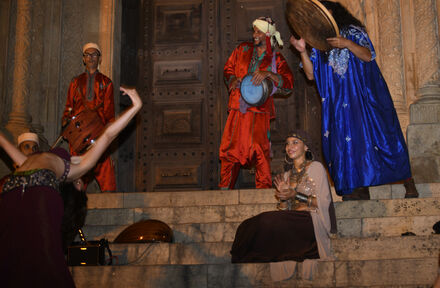
The format itself sets the tone before a single business objective enters the picture. Real jesters, fire breathers, and traditional Portuguese gaita-de-foles bagpipers work the space. Guild-style trading and games run throughout, styled as a genuine reinvention of a real historical tradition rather than a costume party layered over a normal offsite. The point isn't spectacle for its own sake. It's that a group standing inside an atmosphere behaves differently than a group seated in front of one, and that shift in behaviour is where the actual value of the format lives.
Where the Story Carries the Objective
The more interesting design decision, and the one that separates this from pure entertainment, is how a genuine corporate objective gets folded into the fair rather than bolted onto it. Three examples from the concept show the range:
A product introduction becomes "The Guild's Secret Weapon" - the product framed as a closely guarded medieval invention, teams trading and solving riddles across the fairgrounds to earn the right to see it first, before a theatrical reveal from a locked iron chest. The reveal ends with teams pitching the product back to the room in their own "Town Crier" style, turning a Q&A into performance.
A merger becomes "The Alliance of the Two Kingdoms" - leadership from both legacy companies opening the event with a symbolic treaty signing or the blending of two wines into one goblet, followed by intentionally mixed teams designing a new joint crest and competing together, not against each other, in the day's tournament games. A transition that often carries real anxiety gets reframed as a story two groups build side by side.
A sales kick-off becomes "Conquering New Territories" - a stylised map of real target markets marked as unconquered lands, teams earning resources through skill challenges to build working mini-catapults, and a finale where those catapults launch at targets representing actual sales quotas. Hitting the target is the metaphor and the mechanic at once.
None of these are a slideshow with a theme painted over it. The objective is the thing being physically done, not the thing being announced afterward.
Designing for Every Kind of Attendee
The concept's four zones (the Royal Court for speeches and reveals, the Tavern & Stalls for relaxed networking, the Tournament Field for high-energy games, and the Guild Square for quieter strategy and riddle-solving) exist for a specific reason: a single format inevitably suits some attendees more than others. Splitting the day across zones built for different temperaments means an introvert working through the Guild Square and an extrovert cheering on the Tournament Field are both having their best possible version of the same event, at the same time, without either being asked to perform outside their comfort.
Why It Actually Works
Stripped of the medieval framing, the underlying case for this kind of format rests on three things worth any planner's attention regardless of theme:
Retention. People forget data delivered from a stage. They don't forget the time they built a working catapult with the VP of Finance to hit a sales target. A festivalised structure turns information into a physical memory, which is the only format that reliably survives past the following Tuesday.
Inclusivity. Because the layout itself flexes to different personality types rather than asking the room to flex to one activity, the day works for the whole group simultaneously instead of favouring whoever happens to enjoy the one thing on offer.
Alignment. The roleplay maps directly onto real corporate dynamics with almost no translation needed. Guilds become departments. Kingdoms become markets. The crown becomes the company mission. That's not a metaphor stretched to fit. It's the same structure, wearing different names.
The full concept, including how each corporate objective maps to its specific in-fair mechanic, is worth a look for any planner weighing whether a themed structure could carry more than entertainment value alone: Concepts to Festivalize Your Event: The Medieval Fair.
The Actual Question Worth Asking
Festivalisation isn't really a format decision. It's a decision about what you're actually asking your attendees to do at your event: watch something happen, or be inside it while it happens. The second option costs more thought to design. It's also the only one people are still talking about a year later.