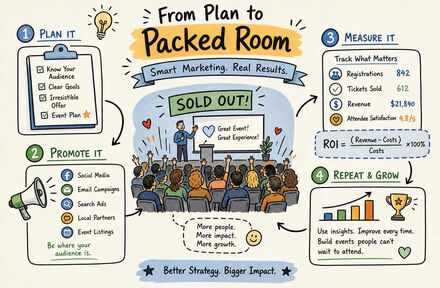



Free listings, zero platform fees, and — the part most ticketing companies can’t offer — an audience that is already there when you hit publish.
Ask any independent organizer what the hardest part of running an event is, and almost nobody says "selling tickets." They say filling the room. They say making the numbers work after the platform takes its cut. They say waiting on money they earned three weeks ago.
Ticketing platforms have gotten very good at the easy part — processing a transaction — and have quietly outsourced the hard parts back to you. You bring the audience. You pay for the ads. You post the link on Instagram. Then the platform charges a service fee, a processing fee, and sometimes an organizer fee on top of it, and holds the proceeds until the event is over.
Jabburr was built on a different assumption: the platform should carry some of the weight.
1. Zero platform fees, and no plan to upgrade to
Listing an event on Jabburr is free. Not free-for-your-first-event, or free-until-you-sell-a-hundred-tickets. There is no organizer plan, no monthly subscription, and no setup cost, and you can list as many events as you want.
Jabburr charges event sellers zero platform fees. Compare that to the standard model, where service fees, processing fees, and organizer fees stack on top of each other — which means your fans pay more at checkout and you take home less per ticket. On a $30 ticket, a few dollars of stacked fees is the difference between an event that clears and one that just barely doesn’t.
The fee structure isn’t a pricing decision. It’s a statement about who the platform thinks the event belongs to.
2. A listing page is not an audience
This is the difference that matters most, and it’s the one that’s hardest to see on a pricing comparison chart.
Most ticketing platforms are, functionally, search pages. Your event goes live and then sits there, waiting for someone to type the right words into a box. All the actual promotion — the posts, the stories, the paid boosts, the emails — happens somewhere else, on platforms that throttle your reach and then sell it back to you.
On Jabburr, ticketing isn’t a separate service you bolt onto your marketing. It’s native to a social network where people are already scrolling. When you publish, your event lands in the feeds of your page’s followers plus locals who follow your city, your venue, and your scene. Recommendations are driven by who a person actually follows — not by who paid the most to be seen.
And there is no "boost this post" upsell, because there’s nothing to unlock. Every follower of your event page sees every post you make. Announcements, lineup drops, weather updates, last-call reminders, the photo dump afterward — all of it reaches the people who asked to hear from you.
That also means the conversation stays in one place. On the usual setup, your event is a link in a bio: the ticket is on one app, the discussion is on another, the photos and after-party plans are on a third. On Jabburr, discovery, RSVPs, ticket purchase, pre-event hype, and post-event follow-up all live on the same page — which is exactly the audience you want to still have when you announce the next one.
3. Cash flow that respects the fact that you have bills
Plenty of platforms hold your ticket revenue until after the event ends. For a large promoter with a credit line, that’s an annoyance. For an independent organizer paying a deposit on a venue, a sound engineer, and a print run, it’s a real financing problem — one that people solve with credit cards, receivables financing, and a lot of stress.
Jabburr automates payouts three days after the event, deposited directly. After you’ve run six events on the platform, you can be approved for advance payouts — so the track record you build actually earns you something.
4. One app, from publish to door scan
Creating an event takes a short guided flow: the basics, date and place, categories, ticket types, then a preview before you publish. No dashboard training, no plan-upgrade prompts halfway through.
Then, on event day, the part most platforms get wrong: check-in. Nearly every ticketing service makes your door staff download a separate scanner app, sign into a separate account, and hope it works. On Jabburr, scanning is built in. Open the app, tap scan, run the door. Tickets are bought, stored, and scanned inside Jabburr — attendees don’t get bounced through five tabs and an email confirmation to find their QR code at the gate.
Managing the event is equally direct. From the organizer view you can:
• Refund a single ticket, refund all tickets, or cancel the event outright
• Track sales as they happen
• Post updates that reach every follower of the event
• Run check-in from the same app your attendees already have open
5. Real attendees, not bots and scalpers
Scalpers scooping inventory and bots inflating engagement are treated as background noise on most platforms — partly because the platforms still get paid either way. Jabburr blocks bots aggressively and verifies users and businesses at no cost, so the engagement numbers on your event page correspond to people who might actually show up.
The privacy posture is part of the same idea. Jabburr doesn’t run behavioral tracking, doesn’t sell user data, and deletes a user’s data when they delete their account. For an organizer, that means the people who buy your tickets aren’t being packaged up and resold to whoever is running the competing event across town.
And if something goes wrong at 6pm on a Friday with doors at 8, there’s a real human on customer service — not a help center article and a form.
6. Works for the events you actually run
Not every event is a 500-cap ticketed show. Jabburr handles the full range with the same flow, the same payouts, and the same audience:
• Local shows, markets, and festivals
• Workshops, classes, and meetups
• Community gatherings and free events
• Virtual events hosted on Zoom, Google Meet, or any venue you like
Whether you’re selling $15 tickets to a room of 60 or running a free community day, the setup is identical.
The honest version of the pitch
Jabburr is not the biggest ticketing platform, and if you need enterprise seat maps and a dedicated account team, that’s not what this is.
What it is: a place to list your events for free, keep the fees off your ticket price, get paid on a predictable schedule, run the door without a second app, and put your event in front of people in your city who are already scrolling — without paying for the privilege of reaching followers you already earned.
If the last event you ran left you wondering where a chunk of the ticket revenue went, that’s the whole argument.
Start listing free at jabburr.com/for-businesses/events — no plan, no monthly fee, no setup cost.