Old Crafts at the Gouda Cheese Market
Why are the Old Crafts so important to the Gouda Cheese Market? And why were these specific craftspeople chosen? In this article, we explain the role these crafts have played in Gouda's history.
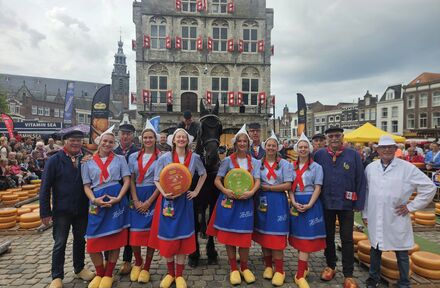
Every week, craftspeople are on display at the Gouda Cheese Market. In addition to the world-famous hand clap performed by traders and farmers, artisans demonstrate their often-forgotten trades of the past. This brings Gouda's rich history back to life.
Candle maker
The history of the candle began in 1853 with the founding of the Stearine Candle Factory. This factory, which produced high-quality candles that burned brightly and drip-free, was even granted the "Royal" designation in 1899. In June 1983, the company's candle department was acquired by the well-known Bolsius Candles factory in Schijndel, but candle production was moved to Waddinxveen.
To celebrate the factory's 100th anniversary in 1956, Gouda's town hall was illuminated with candles for the first time.
Gouda by Candlelight has been around since 1956. The event takes place on a day in December, when the festive lights on the large Christmas tree in the Market Square are turned on. When the electric lights in the surrounding area are turned off and thousands of candles are lit, a magical, fairytale atmosphere is created.
These days, there's no longer a candle factory in Gouda, but its history is so deeply ingrained that this craft is still on display at the Gouda Cheese Market. The candlemaker took official classes at the Gilde in Haarlem. A wide selection of candles, including pillar candles, block candles, dipped candles, pyramids, witch's hats, and floating candles, all with a beautiful print. The candlemaker also demonstrates the decorating and dipping process.
***************************************************************************************
Broom binder
Household products like brooms used to be indispensable. The broom maker played a vital role in the daily lives of the washerwoman and housewife. The yard had to be clean (because what would the neighbors think if you skipped a week?), the laundry was beaten out, and gardening and plumbing chores were made easier thanks to his expertise.
The Broom Broommaker has a huge collection of well-known and unique brushes in all shapes and sizes. Looking for an unusual brush for a specific job? He's sure to have it. He can't make everything himself, unfortunately, that's no longer possible. But you'll see a special stall with a brush for every job you won't find in a store. He also demonstrates making witches' brooms and small hand brushes. He makes these with a touch of humor. For example, "parking only for women" or with a handbell.
****************************************************************************************
Stroopwafel Baker
In 1870, the Gouda Stroopwafel became famous both at home and abroad. Originally, the waffle was made as a cheap "poor man's cake" from cookie crumbs, dough scraps, and syrup. In the 19th century, there were hundreds of stroopwafel makers in Gouda. Now, that number has decreased considerably, but production is so high that many shops sell them.
The Stroopwafel Bakery at the Gouda Cheese Market makes them on the spot and you can enjoy them warm.
****************************************************************************************
Mustard maker
Until 1969, Gouda was a prominent player in the mustard and vinegar industry. Due to takeovers at that time, this industry disappeared from the city (city rights since 1272).
The Mosterdmaker has a wide selection of mustards. All sorts of flavors you've probably never heard of: Fig, Dill Honey, Spicy, Farmer's Mustard, Yummy Yummy Sauce, and more. You can taste them before you buy.
At her stall, she also has various flavors of dried sausages. These, of course, aren't made on-site; they're pre-made and have been drying for weeks. Some are smoked.
Choice of: Drenthe cloves, spicy, Italian/Mediterranean herbs, walnut, garlic, etc.
****************************************************************************************
Gouda Pottery/Potter
From the 17th century until the mid-20th century, Gouda was known for its potteries and patinated wares.
Several potteries in the city produced world-famous Gouda pottery and earthenware. Plateel is a hand-painted Art Nouveau and Art Deco style.
At the Gouda Museum, behind the Sint Janskerk, you can view a large collection of Gouda pottery.
The craftsman with the cargo bike makes pots on-site, but he also has a lovely shop and workshop space where you can take a course yourself. You'll find this behind the Waag at Zeugstraat 92.
****************************************************************************************
Woodworker
Woodworking from the Middle Ages can still be found in old buildings in Gouda, such as in the Lage Gouwe and Zeugstraat, where details such as wall styles, corbels (consoles) and beams.
Around 1600, oak became more difficult to obtain, so lighter pine was substituted for things like side walls. However, more of it had to be used for strength.
The woodworker you can visit at the Gouda Cheese Market works primarily with scrap wood from DIY stores and beachcombers. Living near the sea, he can scour the beaches and create all sorts of creations from found wood.
***************************************************************************************
Cheesemakers
That's what the Gouda Cheese Market is all about, of course. Every week, a couple stands by the appropriate yellow tent to tell you all about the fascinating process of making cheese from cow's milk. They explain what rennet and whey are—important components in cheesemaking.
The cheese made at the market is distributed in small cubes to interested visitors who approach the barrel. Be sure to stop by the friendly farming couple and learn firsthand from the experts.
***************************************************************************************
Stained glass/ Tiffany
The history of stained glass in Gouda is closely linked to the famous Gouda stained glass windows in St. John's Church, created by the Crabeth brothers in the 16th century. These impressive windows tell biblical and historical stories and can still be admired today.
The Tiffany technique originated around 1890 and is named after Louis Comfort Tiffany. It involves wrapping pieces of glass with copper foil and soldering them together, allowing for refined and detailed work. At the Cheese Market, the craftswoman focuses primarily on Tiffany creations such as lamps, window hangings, and panels. Her presence varies; keep an eye on the Facebook page @OudHollandsEntertainment for updates.
***************************************************************************************
Glass engraving
Engraved glass has traditionally been a luxury product.
Long ago, when fire and sand first met, glass was born: smooth, clear, and mysterious. In ancient Egypt, craftsmen discovered that with sharp stones and patience, they could scratch tiny lines into the glass. They primarily engraved symbols for gods and pharaohs.
Centuries later, in the Roman Empire and especially in medieval Venice, glass engraving became more refined. Masters used metal wheels and sand to draw graceful flowers, myths, and family crests.
Today, glass engraving lives on, but with modern tools. The craftswoman demonstrates the refined art of glass grinding. You can, for example, have a name or image engraved on a glass or mirror.
***************************************************************************************
Wool spiders
The cloth industry in Gouda's textile past was a complex network involving many crafts. Especially in the Middle Ages, Gouda was a vibrant center for wool spinning.
The cloth industry (processing wool into cloth) flourished, with crafts such as washing, dyeing, combing, spinning, and fulling (folle, stamping with bare feet).
Around 1900, flax and hemp were also spun, and crafts such as rope making, candle wick braiding and sail making were needed.
In 1861, the Goudsche Machinale Garenspinnerij (Goudse Machinale Garenspinnerij) was established in Gouda on Turfsingel. The factory produced wool and yarn using modern steam engines. The company grew rapidly and became a major employer in the city. More and more buildings were added, and hundreds of people worked there.
In the twentieth century, the factory faced difficulties. Competition was fierce, and new materials weren't working well. Although the company received the Royal title in 1961, the number of employees declined. In 1981, the factory moved to Waddinxveen.
Fortunately, the old factory in Gouda survived. Instead of being demolished, the building was converted into the Garenspinnerij Cultural Center. Now a venue for theater, cultural activities, and childcare, it preserves an important piece of Gouda's history.
The two wool spinners take turns and both have brightly colored stalls where enthusiasts can find spun and dyed wool and various creations that have already been made.
***************************************************************************************
Mosaic
Gouda also boasts a rich mosaic tradition. Mosaics can be found in St. John's Church and at various locations throughout the city. A well-known example is the work by Cor Dam, originally created for the Anne Frank School and now on display at the De Eendracht apartment complex in Gouda East. Mosaics by artist Janny Brugman-de Vries can also be found at Nonnenwater.
The mosaic artist at the Cheese Market sells, among other things, tea light holders, letters, numbers, butterflies and jewelry made with glass mosaic.
***************************************************************************************
Beekeeper
Beekeeping in Gouda used to be seen more as a small-scale household activity. Nowadays, there are several beekeepers in and around the city who also supply the food chain. This also applies to the craftsman. As a child, he took one course after another and shadowed his predecessors.
At the Gouda Cheese Market, the beekeeper brings home-grown honey products. His stock includes flower honey, orange blossom honey, lemon honey, sage honey, fennel honey, and chestnut honey. She uses orchard products to create all sorts of delicacies, such as apple and pear jam, chutneys, almond paste, Four-rovers vinegar, fire cider, and three types of mustard. Honey mustard, of course, but also a medieval mustard made from black mustard seed.
***************************************************************************************
Chair mat
Chairs have of course always been important in the history of Gouda and the Netherlands as a whole.
As an antique restorer, chair wickerwork has been in her family for generations. The Chair Maker learned her craft from her father. Besides being an antique collector, he also restored all sorts of things, including wicker chairs. Depending on the chair's history, she works with rattan, rushes (a type of grass that can reach 3 meters in height), chair cane, papercord, and seagrass. The chair pattern sometimes has as many as six layers.
At the Gouda Cheese Market, she'll demonstrate how this is done. Some chairs have six layers of woven wicker. She's so fast that they can be finished in one to one and a half days. She also accepts commissions.
***************************************************************************************
Clog maker
Since the 12th century, clogs have been worn by clogs, especially on cheese farms and in the countryside. They were made of willow or poplar wood. At the Gouda Cheese Market, farmers still wear clogs while trading cheese.
But the whole of the Netherlands is known to tourists as a clog country. Initially, they were carved and shaped by hand; a block of wood was worked into shape with an axe and knife, after which the block was hollowed out with a chisel. Physically, it was a very demanding profession. Later in the 20th century, it was also made mechanically, causing the craft to slowly die out. During the First World War, there was a temporary boom in clog making and wearing, as leather for footwear became very scarce.
The clog maker brings along an old-fashioned workbench to explain how the process was done by hand. A popular craft among tourists. But clogs can also be a godsend for your daily work or gardening, providing warmth and making them easy to get on and off.
****************************************************************************************
Practical information
The Gouda Cheese Market is open every Thursday from April 2nd to August 27th, 2026, from 10am to 12.30pm on the Markt, between the former Town Hall and the Waag, in Gouda.
nl
Oude Ambachten op de Goudse Kaasmarkt
Waarom zijn de Oude Ambachten zo belangrijk voor de Gouda Kaasmarkt? En waarom is er gekozen voor deze specifieke Ambachtslieden. In dit artikel leggen wij uit welke rol deze ambachtelijke beroepen hebben gespeeld in de geschiedenis van Gouda.
Iedere week staan er ambacht op de Gouda Kaasmarkt. Naast het wereldberoemde handje klap uitgebeeld door de handelaren en boertjes demonstreren de ambachtslieden hun vaak vergeten beroepen van vroeger. Zo komt de rijke geschiedenis van Gouda opnieuw tot leven.
Kaarsenmaakster
In 1853 begint de geschiedenis van de kaars door de oprichting van de Stearine Kaarsenfabriek. De fabriek met kwaliteitskaarsen die helder en druipvrij branden krijgt in 1899 zelf het predicaat ‘Koninklijk’. In juni 1983 werd de kaarsenafdeling van het bedrijf overgenomen door de fabriek van de welbekende Bolsius Kaarsen te Schijndel, maar de productie van kaarsen werd verplaatst naar Waddinxveen.
Ter viering van het 100-jarig bestaan, in 1956, van de fabriek werd voor het eerst het stadhuis van Gouda verlicht met kaarsen.
Gouda bij Kaarslicht bestaat al sinds 1956. Het evenement vindt plaats op een dag in december, wanneer de feestverlichting in de grote kerstboom op de Markt aangezet wordt. Wanneer in de wijde omgeving de elektrische verlichting wordt gedoofd en duizenden kaarsen aangaan dan ontstaat er een magische sprookjessfeer.
Vandaag de dag is er geen kaarsenfabriek meer in Gouda, maar deze historie zit zo diepgeworteld in het geheugen dat dit deze ambacht nog steeds te zien is tijdens de Gouda Kaasmarkt. De Kaarsenmaakster heeft officiële lessen gevolgd bij het Gilde in Haarlem. Een ruime keuze van bijvoorbeeld stompkaarsen, blokkaarsen, dompelkaarsen, piramides, heksenhoed en drijfkaarsen met allen een mooie print er op. De Kaarsenmaakster laat ook het decoreren en dompelen zien.
*******************************************************************************************
Bezembinder
Huishoudelijke producten zoals bezems waren vroeger onmisbaar. De bezembinder speelde een belangrijke rol in het dagelijks leven van de was- en huisvrouw. Het erf moest schoon zijn (want wat zouden de buren wel niet denken als men een week over slaat), de was werd uitgeklopt en tuin- en sanitaire klusjes werden vergemakkelijkt dankzij zijn vakmanschap.
De Bezembinder heeft een enorme verzameling bekende en unieke borstels in allerlei soorten en maten. Zoekt u een ongewone borstel voor een bepaalde klus, hij heeft het vast en zeker. Niet alles kan hij zelf maken, dat gaat helaas niet meer. Maar u ziet wel een speciale kraam, met voor ieder klusje een borstel die u niet zomaar in de winkel kunt vinden. Hij demonstreert ook het maken van heksenbezems en kleine handborstels. Deze maakt hij met een grap en een grol. Bijvoorbeeld alleen parkeren voor vrouwen of met een handbel.
********************************************************************************************
Stroopwafel Bakker
In 1870 werd de Goudse Stroopwafel bekend in binnen- en buitenland. Oorspronkelijk werd de wafel gemaakt als een goedkope ‘armenkoek’ van koekkruimels, deegresten en stroop. In de 19e eeuw waren er honderden stroopwafels maker in Gouda. Nu is dat weer een heel stuk minder, maar is de productie zo groot dat er veel winkels zijn die die ze verkopen.
De Stroopwafel Bakker op de Gouda Kaasmarkt maakt ze ter plekke en u kunt ze heerlijk warm lekker oppeuzelen.
********************************************************************************************
Mosterdmaker
Tot aan 1969 had Gouda een prominente speler wat betreft de mosterd- en azijnindustrie. Door overname toentertijd verdween deze uit de stad (stadsrechten sinds 1272).
De Mosterdmaker heeft een flinke keuze aan soorten mosterd. Allerlei smaken die u vast niet allemaal kenden; Vijgen, Dille honing, Pittig, Boerenmosterd, Jummie Jummie saus, etc. U kunt ze ter plekke proeven voordat u ze koopt.
Op haar kraam heeft ze ook diverse smaken gedroogde worsten. Deze maakt ze uiteraard niet ter plekke, maar zijn vooraf al gemaakt en hebben weken liggen drogen. Sommige zijn gerookt.
Onder andere keuze uit: Drenthe kruidnagel, Pikante, Italiaanse/ Mediterrane kruiden, Walnoot, Knoflook etc.
********************************************************************************************
Gouds Plateel/ Pottenbakker
In de 17e eeuw tot half 20e eeuw stond Gouda bekend om zijn pottenbakkerijen en pateel.
Diverse pottenbakkerijen in de stad produceerden wereldberoemd Gouds plateel en aardewerk. Plateel is een handbeschilderde Jugendstil- en Art-Decostijl.
Het Museum Gouda, achter de Sint Janskerk, kunt u een grote collectie Gouds Plateel bekijken.
De ambachtsman met de bakfiets maakt ter plekke potjes, maar heeft ook een mooie winkel en workshop ruimte waar u zelf een cursus kunt volgen. Deze vindt u achter de Waag op Zeugstraat 92.
********************************************************************************************
Houtbewerker
Houtbewerking uit de Middeleeuwen is nog altijd terug te vinden in oude panden in Gouda, zoals in de Lage Gouwe en Zeugstraat, waar details zoals muurstijlen, korbelen (consoles) en balklagen.
Rond 1600 werd eikenhout moeilijker te verkrijgen, daardoor kwam lichtere grenenhout voor in de plaats in bijvoorbeeld zijmuren. Er moest wel meer van gebruikt worden voor de stevigheid.
De Houtbewerker die u op de Gouda Kaasmarkt kunt bezoeken werkt voornamelijk met afval hout van doe het zelf zaken en juttershout. Daar hij vlakbij zee woont kan hij de stranden afstruinen en van gevonden hout allerlei creaties maken.
*******************************************************************************************
Kazenmakers
Daar draait de Gouda Kaasmarkt natuurlijk om. Elke week staat er een echtpaar bij de toepasselijke gele tent om u alles te vertellen over het mooie proces om van koemelk kaas te maken. Zij leggen uit wat stremsel en wei is. Belangrijke componenten om kaas mee te maken.
De kaas die op de markt gemaakt is wordt in kleine blokjes uitgedeeld aan de geïnteresseerde bezoekers die bij de ton komen staan. Loop zeker even langs het vriendelijke boerenechtpaar en leer van dichtbij van de experts.
*******************************************************************************************
Glas in Lood/ Tiffany
De geschiedenis van glas-in-lood in Gouda is nauw verbonden met de beroemde Goudse Glazen in de Sint-Janskerk, gemaakt door de gebroeders Crabeth in de 16e eeuw. Deze indrukwekkende ramen vertellen Bijbelse en historische verhalen en zijn tot op de dag van vandaag te bewonderen.
De Tiffany-techniek ontstond rond 1890 en is vernoemd naar Louis Comfort Tiffany. Hierbij worden glasstukken omwikkeld met koperfolie en aan elkaar gesoldeerd, waardoor verfijnd en gedetailleerd werk mogelijk is. De ambachtsvrouw richt zich op de Kaasmarkt vooral op Tiffany-creaties zoals lampen, raamhangers en panelen. Haar aanwezigheid wisselt; houd hiervoor de Facebookpagina van @OudHollandsEntertainment in de gaten.
*******************************************************************************************
Glasgraveren
Gegraveerd glas is van oudsher een luxe product.
Lang geleden, toen vuur en zand elkaar voor het eerst ontmoetten, werd glas geboren; glad, helder en geheimzinnig. In het oude Egypte ontdekten ambachtslieden dat ze met scherpe stenen en geduld kleine lijnen in het glas konden krassen. Ze graveerden voornamelijk symbolen voor goden en farao’s.
Eeuwen later, in het Romeinse Rijk en vooral in het middeleeuwse Venetië, werd glas graveren verfijnder. Meesters gebruikten metalen wieltjes en zand om sierlijke bloemen, mythen en familiewapens te tekenen.
Vandaag leeft het glas graveren voort, maar met moderne gereedschappen. De ambachtsvrouw toont de verfijnde kunst van het glas slijpen. U kunt bijvoorbeeld een naam of afbeelding laten graveren in een glas of spiegel.
*******************************************************************************************
Wolspinnen
De Lakennijverheid in het textielverleden van Gouda was een complex netwerk waar vele ambachten aan deel namen. Met name in de middeleeuwen was Gouda een bruisend hart voor wolspinnen.
Lakennijverheid (wol verwerken tot laken) bloeide, met ambachten als wassen, verven, kammen, spinnen en voll. (folle, stampten met blote voeten)
Rond 1900 werd ook vlas en hennep gesponnen, en waren er ambachten zoals touwbanen, kaarsenpitten vlechten en het maken van zeilen nodig.
In 1861 werd in Gouda de Goudsche Machinale Garenspinnerij opgericht aan de Turfsingel. In de fabriek werd wol en garen gemaakt met moderne stoommachines. Het bedrijf groeide snel en werd een belangrijke werkgever voor de stad. Er kwamen steeds meer gebouwen bij en honderden mensen werkten er.
In de twintigste eeuw kreeg de fabriek het moeilijk. Er was veel concurrentie en nieuwe materialen werkten niet goed. Hoewel het bedrijf in 1961 nog het predicaat Koninklijk kreeg, nam het aantal werknemers af. In 1981 verhuisde de fabriek naar Waddinxveen.
De oude fabriek in Gouda bleef gelukkig bestaan. In plaats van sloop werd het gebouw verbouwd tot het Cultuurhuis Garenspinnerij. Nu is het een plek voor theater, cultuur en kinderopvang, en blijft een belangrijk stukje geschiedenis van Gouda bewaard.
De 2 Wolspinsters wisselen elkaar af en hebben beide vrolijk gekleurde kramen waar de liefhebbers gesponnen en geverfde wol kunnen vinden en diverse creaties die al gemaakt zijn.
*******************************************************************************************
Mozaïek
Gouda kent ook een rijke mozaïektraditie. Zo bevindt zich mozaïek in de Sint-Janskerk en op diverse plekken in de stad. Een bekend voorbeeld is het werk van Cor Dam, oorspronkelijk gemaakt voor de Anne Frankschool en nu te zien bij appartementencomplex De Eendracht in Gouda Oost. Ook aan het Nonnenwater is mozaïek te vinden van kunstenares Janny Brugman-de Vries.
De mozaïekkunstenares op de Kaasmarkt verkoopt onder andere waxinelichtjes houders, letters, cijfers, vlinders en sieraden met glasmozaïek.
*******************************************************************************************
Imker
De Imkerij in Gouda werd vroeger meer gezien als een kleinschalige huishoudelijke bezigheid. Tegenwoordig zijn er in en rondom de stad meerdere Imkers die ook leveren aan de voedselketen. Dit geldt ook voor de ambachtsman. Als kind heeft hij de ene na de andere cursus gedaan en meegelopen met zijn voorgangers.
De Imker neemt tijdens de Gouda Kaasmarkt zelf verworven honing producten mee. Zijn voorraad bestaat onder andere uit Bloemenhoning, Oranjebloesemhoning, Citroenhoning, Saliehoning, Venkelhoning en Kastanje honing. Zij maakt van boomgaardproducten allerlei lekkernijen; zoals Appel en peren jam, chutneys, Amandelspijs, Vierroversazijn, Vuurcider en 3 soorten mosterd. Uiteraard de honingmosterd, maar ook een Middeleeuwse mosterd van zwart mosterdzaad.
*******************************************************************************************
Stoelenmatter
Stoelen zijn natuurlijk altijd al belangrijk geweest in de geschiedenis van Gouda en in heel Nederland.
Als antiek restaurateur zit het vlechten van stoelen al generaties in haar familie. De Stoelenmatter heeft haar beroep van haar vader geleerd. Naast antiek verzamelaar knapte hij ook van alles op, waaronder rieten stoelen. Zij werkt afhankelijk van de geschiedenis van de stoel met rotan, biezen (grassoort van wel 3 meter hoog), stoelriet, papercord en zeegras. Het stoelenpatroon heeft soms wel 6 lagen.
Op de Gouda Kaasmarkt laat zij zien hoe dit in zijn werk gaat. Sommige stoelen hebben we 6 lagen gevlochten riet. Ze is zo snel dat deze binnen 1 á 1,5 dag wel klaar is. Zij neemt ook opdrachten aan.
*******************************************************************************************
Klompenmaker
Sinds de 12e eeuw is Klompenmaker droeg met zeker op de kaasboerderijen en het platteland klompen. Ze werden van wilgen- of populierenhout gemaakt. Op de Gouda Kaasmarkt dragen de boertjes tijdens het kaas handelen nog steeds klompen.
Maar heel Nederland staat bij de toeristen bekend als een klompenland. Eerst werden ze met de hand gesneden en bijgewerkt, met bijl en mes werd een blok hout in de vorm bewerkt en waarna het blok verder uitgehold werd met een beitel. Fysiek een erg zwaar beroep. Later in de 20e eeuw werd het daarom ook machinaal waardoor het beroep langzaam uitsterft. In de Eerste Wereldoorlog was er een tijdelijke bloeiperiode voor het maken en dragen van klompen, daar leer voor schoeisel erg schaars werd.
De klompenmaker neemt een ouderwetse werkbank mee om te vertellen hoe het met de hand in zijn werk ging. Een gewild ambacht onder de toeristen. Maar ook in uw dagelijks werk of werken in de tuin kunnen klompen een uitkomst zijn wat betreft warmte en makkelijk in- en uitstappen.
********************************************************************************************
Praktische informatie
De Goudse Kaasmarkt is iedere donderdag van 2 april tot 27 augustus 2026 te bezoeken van 10.00 tot 12.30 uur op de Markt, tussen voormalig Stadhuis en de Waag in, te … Gouda.